
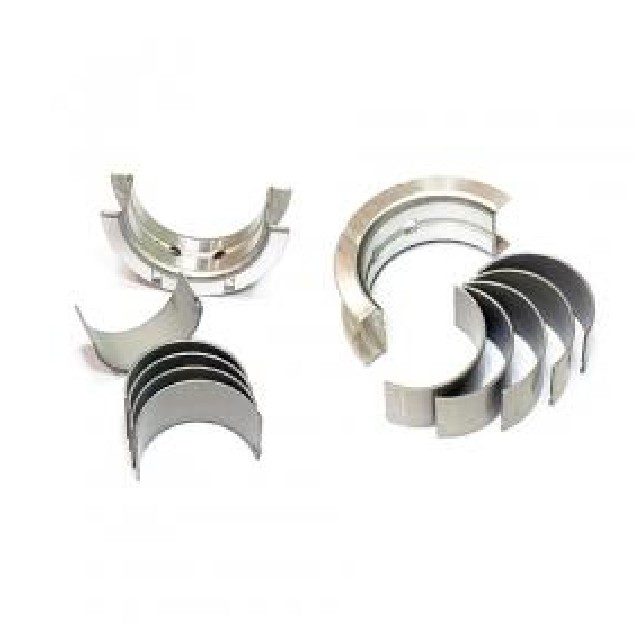
They're steel-backed bimetal parts — a steel shell carrying a copper-alloy (CuPb) running layer. Get the alloy, the wall thickness and the crush height right and the bearing holds its oil film and load for the life of the engine; get them wrong and it fails early. That's why we buy from a vetted network rather than the open market: the parts hold their spec, batch after batch.
What we supply
- Main, connecting-rod and thrust (flanged) bearings
- Plain shells, flange bearings, bushes and thrust washers
- Steel-backed CuPb bimetal, to OE material standards
- Standard and oversize for rebuilds — plus large-diameter shells
- Matched to your engine by application and OE part number
Large-diameter, for high-power diesel
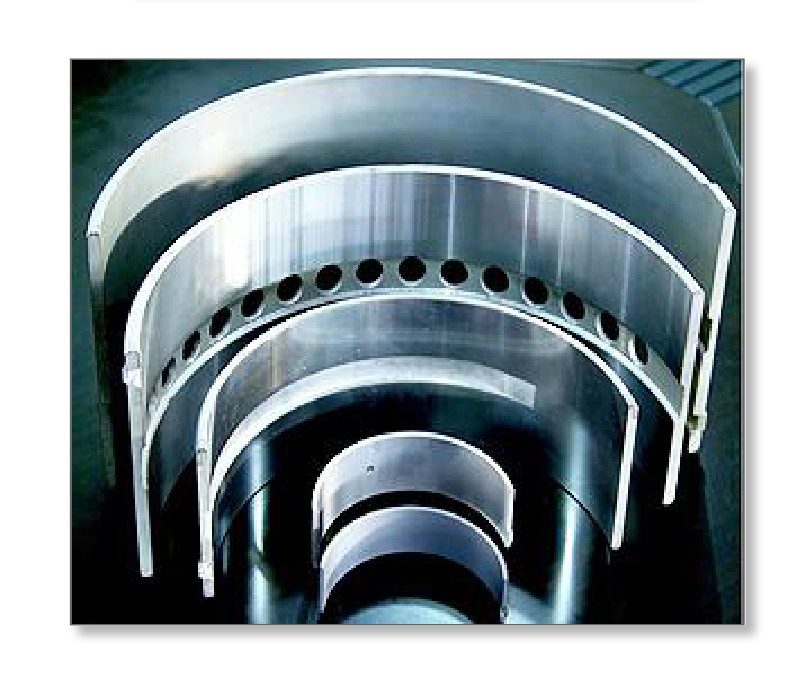
The range runs up to large-diameter shells — roughly Φ200–Φ400 mm — for the high-power diesel engines in ships, rail and heavy industrial plant. These are bearings most traders can't cover; our sourcing network reaches the plants that make them, so we can.
Built to recognised standards
The bearings we source are produced to established sliding-bearing standards, so the spec isn't something you take on trust:
- GB/T 18326-2001 — multilayer metal material for sliding bearings
- ZB T12002 — technical spec for engine main & con-rod bearings
- ZB T12003 — copper-alloy metallography
- GB/T 699-1999 — quality carbon construction steel (the backing)
Bimetal spec, at a glance
| Construction | Steel-backed bimetal, copper-alloy running layer |
|---|---|
| Alloy | CuPb24Sn — Cu 19–27, Pb 0.6–2, P ≤0.1, Fe ≤0.7, Ni ≤0.5 (%) |
| Steel back | Carbon ≤0.22% |
| Thickness tolerance | ±0.03 mm (<4 mm) · ±0.04 mm (4–12 mm) |
| Width tolerance | ±0.5 mm |
| Hardness (plain) | HB ≥118 / HV ≥123 (steel <4 mm) |
| Standards | GB/T 18326 · ZB T12002 · ZB T12003 · GB/T 699 |
Quality at the source
The plants we work with run composition analysis, metallographic checks and hardness testing on their own production, and hold wall thickness to a few hundredths of a millimetre. We pick suppliers on that record and match every order to your engine by part number — so what turns up fits, and the next order matches the last.